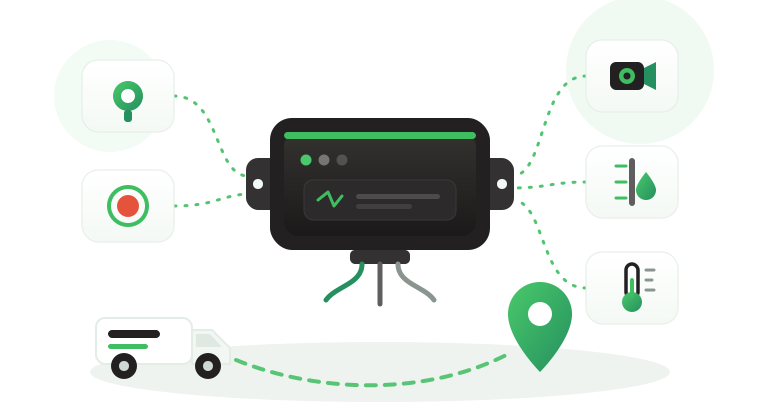


GPS tracking in the UAE has to cover very different working days inside the same fleet. A delivery van leaves Jebel Ali at six in the morning and reaches Fujairah by the afternoon. A water tanker spends hours on a desert site where the signal drops. A service pickup crosses into Oman for a job, and nobody at the office is sure whether its data is still arriving.
This article explains how GPS tracking works for fleets operating in the UAE. It covers the local conditions that shape a deployment, how different fleet types use tracking data, the rules the Tracom ST100 applies inside the vehicle, what to check before choosing a device, how to approach regulation and driver data, and which hardware and accessories to fit in UAE vehicles.
What GPS tracking does for UAE fleets
A GPS tracking device installed in the vehicle calculates position from satellites, records speed and driving events, and sends that data over the cellular network to a tracking platform. Managers then see where each vehicle is, where it has been, and how it was driven. In a fleet spread across several emirates, that removes many of the status calls dispatch would otherwise make every day.
The ST100 calculates position using GPS, GLONASS, SBAS (WAAS, EGNOS, MSAS, GAGAN), QZSS, and AGPS signal receivers, with location accuracy within a 2-meter radius. It records data second by second and supports 2G/3G/4G SIM cards. It also applies rules inside the vehicle, so speed limits, zone events, and driver voice alerts work without waiting for a server.
What the device does not decide
A geofence exit at a free zone gate does not automatically determine whether a delivery is complete, whether a driver broke policy, or whether a customer should be billed. Tracom supplies the GPS device, local rule logic, event data, and configuration layer. The fleet or its connected business software assigns the operational meaning and response.
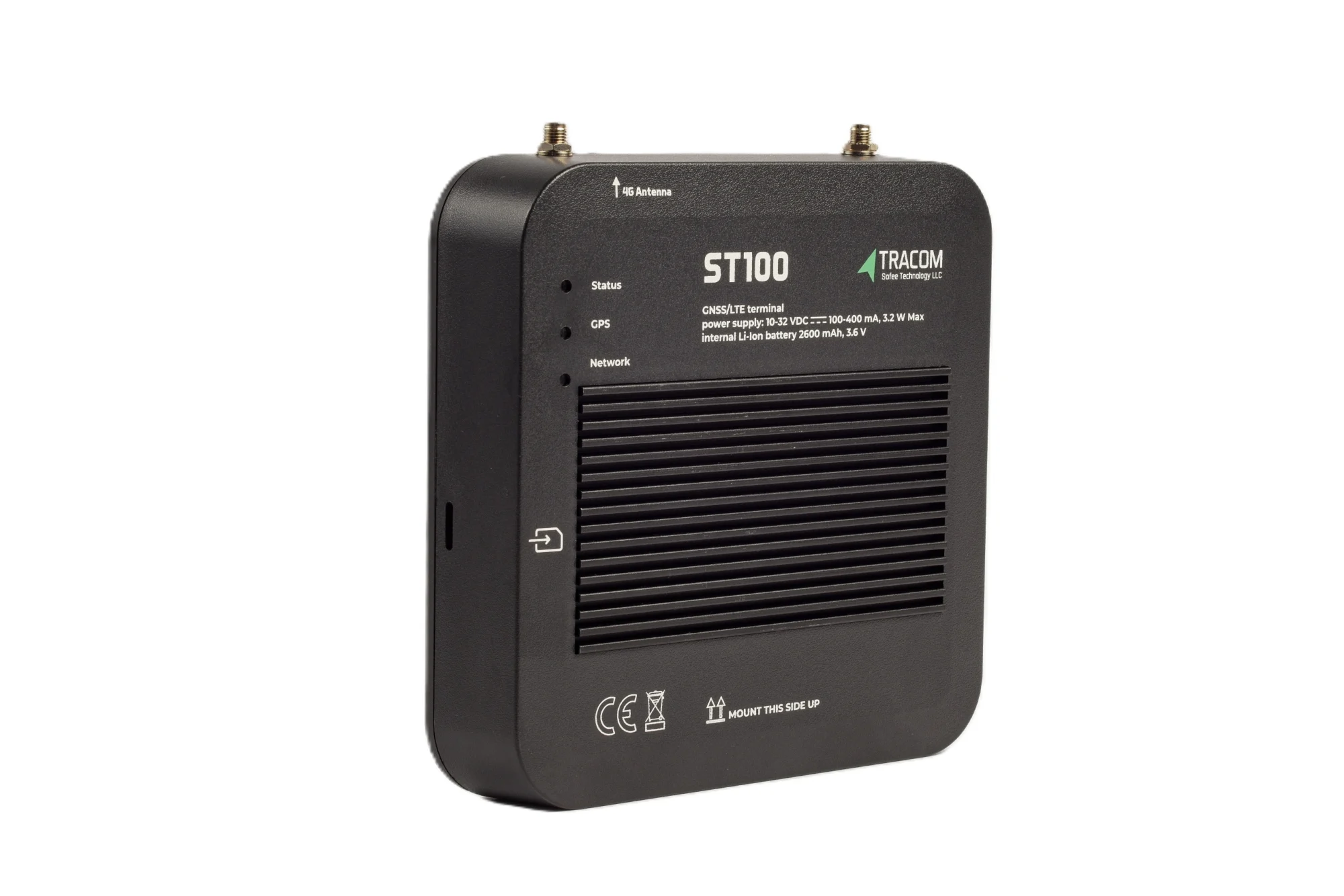
The tracking device behind every record
- GPS, GLONASS, SBAS, QZSS and AGPS positioning
- Location accuracy within a 2-meter radius
- 2G/3G/4G SIM support
- 12 digital, 4 analog and 5 AD inputs, 2 digital outputs
- 5 RS232 ports, USB, UART, 1-Wire and OBD II CAN
UAE conditions that shape a tracking deployment
The same tracker can perform very differently from one market to another, because installation, routes, and coverage change the result. Four conditions matter most for fleets working in the UAE.
Summer heat and installation
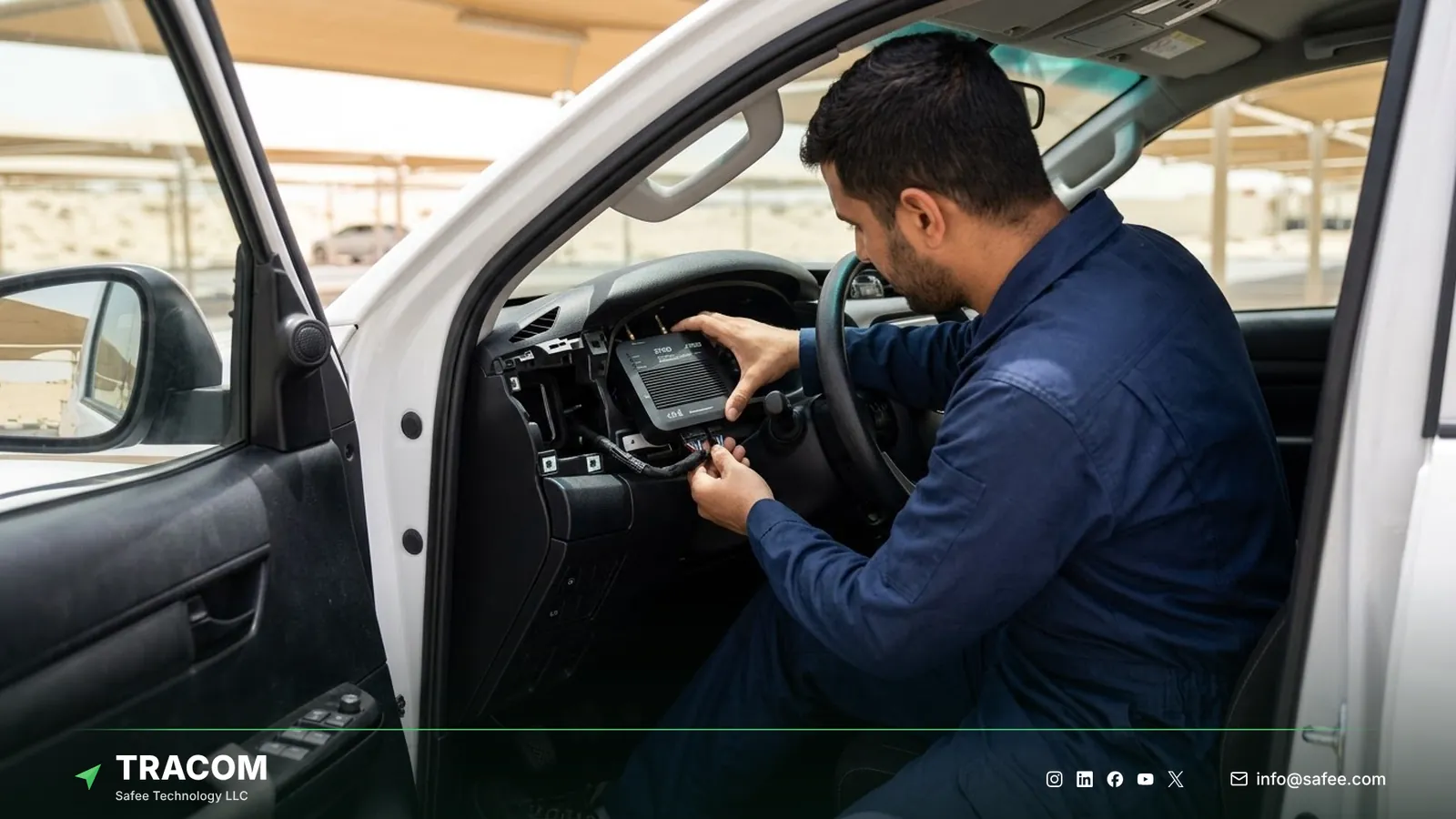
Summer cabin temperatures in a parked vehicle can climb far above the outside air temperature, especially on the dashboard. The ST100 is engineered for demanding environments, harsh outdoor conditions, and strong vibration. For any tracker, ask for the operating temperature specification and mount the unit away from direct sun and heat sources. The guide to GPS tracker placement explains where to install a device inside the vehicle, and the guide to GPS trackers in extreme heat covers summer installation planning in the Gulf.
Long inter-emirate and cross-border routes
Many UAE fleets drive the length of the country in a single shift, and some vehicles regularly enter Oman or Saudi Arabia. Data from a vehicle outside the UAE depends on the SIM plan and its roaming terms, which is a connectivity decision to settle before rollout. When no network is available, the ST100 stores up to one week of data internally and keeps applying its rules.
Remote sites and coverage gaps
Oil and gas fields, desert construction sites, quarries, and some mountain roads in the northern emirates have weak or inconsistent coverage. A tracker that only works while connected leaves gaps in exactly the places where supervisors have the least visibility. Because the ST100 applies its rules without an internet connection, speed rules and voice alerts still work in those stretches.
Dense cities, ports, and free zones
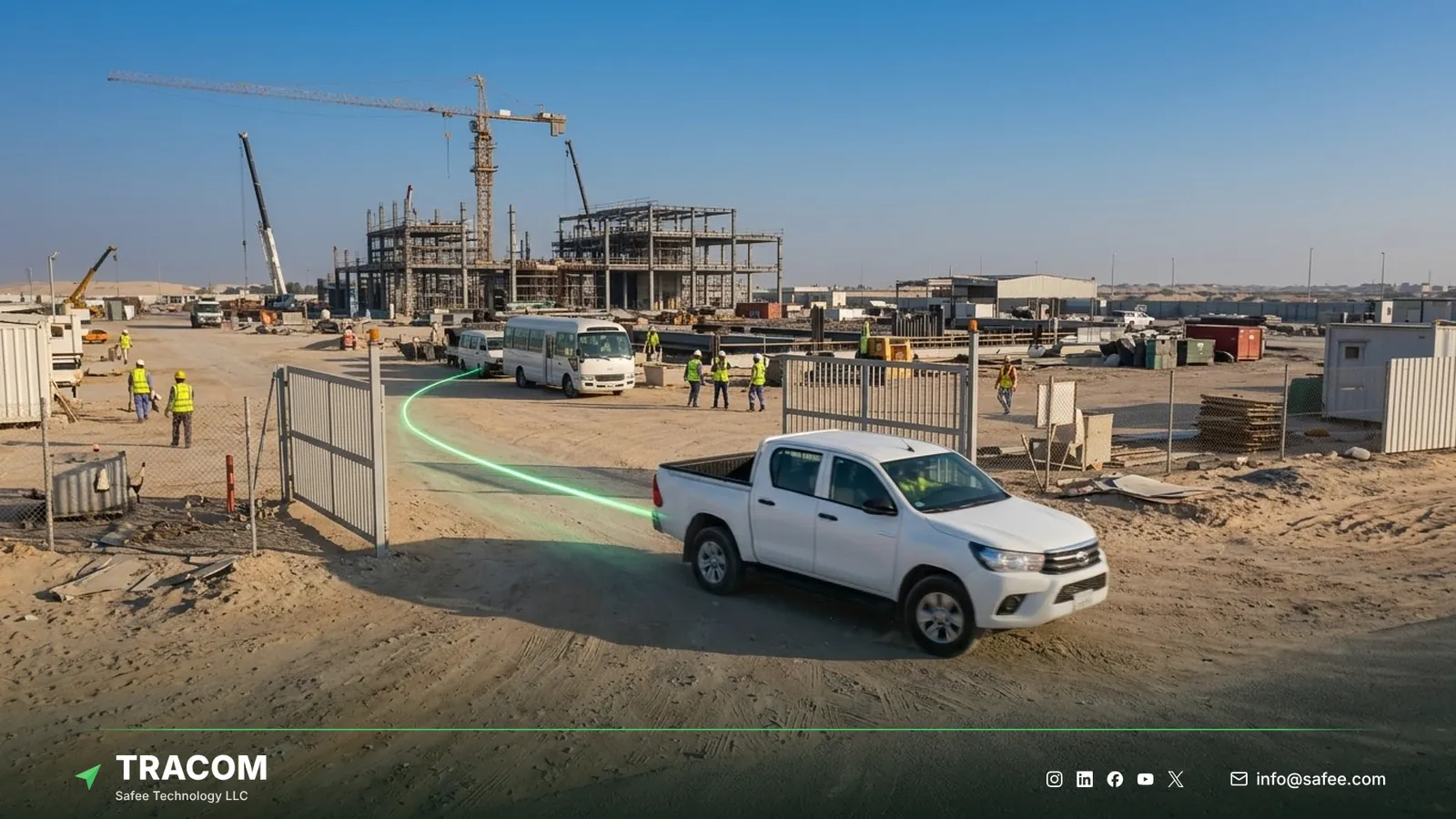
In Dubai, Abu Dhabi, and Sharjah, fleets move between ports, free zones, warehouses, and customer sites within short distances. Geofences around gates, loading areas, and restricted zones turn those movements into clear arrival and departure events. Like any satellite receiver, a tracker can lose accuracy near tall buildings and in covered or underground parking, where the view of the sky is blocked.
Read also: IVMS Device Checklist: What the In-Vehicle Hardware Must Record
How UAE fleets use GPS tracking
Each fleet type uses the same device data for a different decision. The table below links common UAE fleet types to the device event and its operational use.
| Fleet type | Device event | Operational use |
|---|---|---|
| Logistics and last mile | Geofence entry and exit at warehouses and drop points | Confirm arrivals without calling drivers |
| Construction and contracting | Site geofence exit events | Platform flags after-hours use of site vehicles |
| Oil, gas, and remote services | Rules applied offline, up to one week of onboard storage | Keep speed rules running on remote routes |
| Rental and leasing | Driver access keys and immobilization | Limit who can operate each vehicle |
| Corporate and service fleets | Over-speeding and harsh events with voice alerts | Coach drivers on city and highway speed |
| Transport and cargo | Tamper alerts and route deviation reminders | Protect vehicles and cargo between emirates |
Many fleets combine two or three of these uses. A contractor may need site geofences, after-hours alerts, and driver keys on the same vehicles, while a courier fleet focuses on arrival events and speed coaching. Starting with the two uses that cost the most time or money keeps the first rollout focused. The guide to fleet tracking by industry goes deeper into how each sector sets up its devices.
Rules applied inside the vehicle
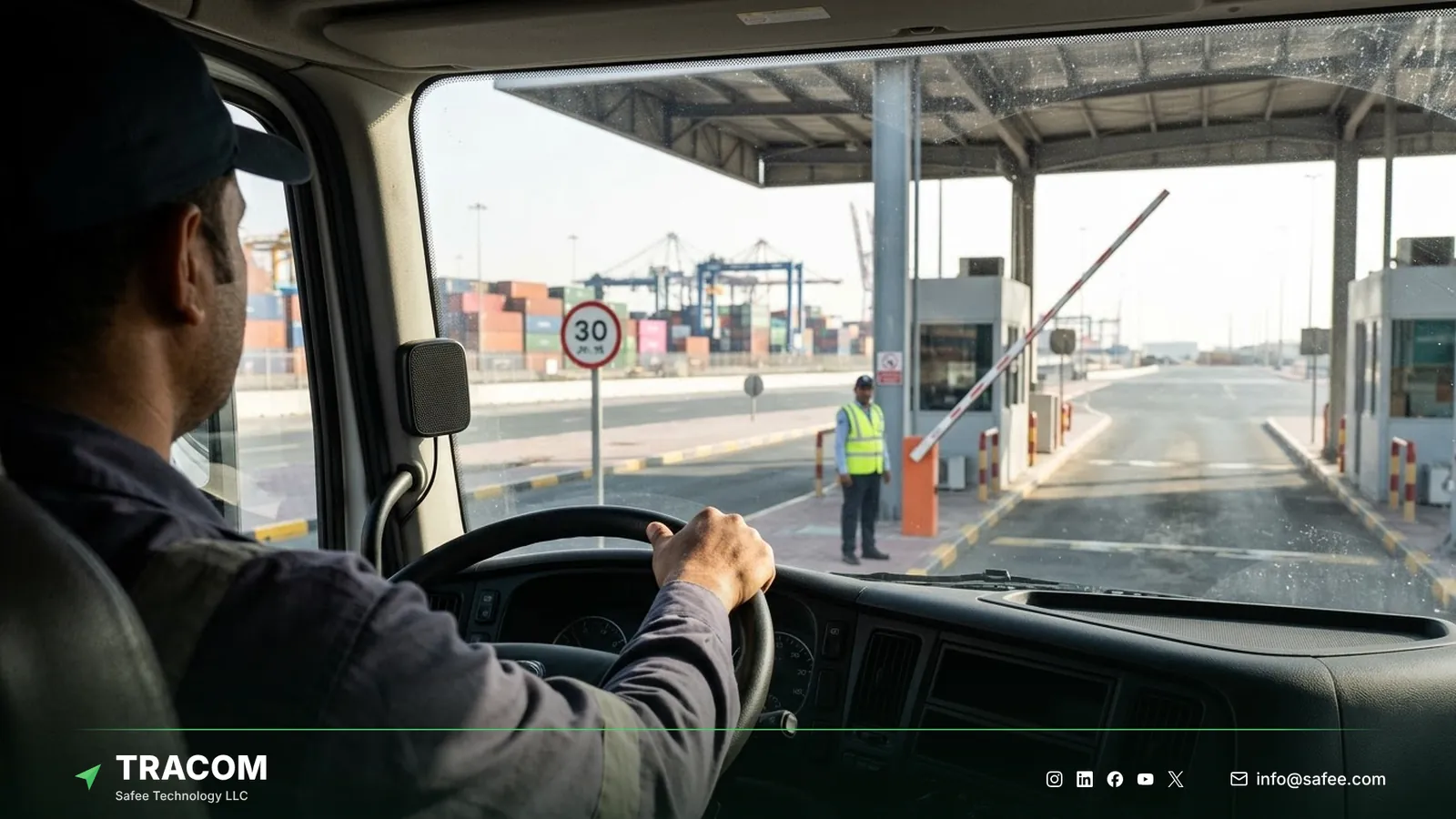
The ST100 is an in-vehicle intelligence system. It applies logic, makes decisions, and executes actions inside the vehicle, so a rule still works when the network is slow or absent.
Speed limits by zone and time
Posted speed limits change often along UAE roads, and many fleets set their own policy below them for loaded or heavy vehicles. The ST100 supports up to 4,000 geofences with time-based speed limits. In a hypothetical example, a fleet could set 25 km/h inside a zone named DXB-JAFZA-GATE-4 during working hours, and a lower limit around a school route at drop-off times. The geofencing fleet management guide covers zone design in detail.
Voice alerts for drivers
The ST100 triggers voice alerts for over-speeding, harsh events, and seat belt violations. It can also activate voice alerts during grace periods on zone speed limits. A voice alert speaks to the driver while the behavior can still be corrected, which is fairer than a call from the control room after the trip.
Access keys, immobilization, tamper, and panic
The ST100 supports up to 1,000 driver access keys. With immobilization, only authorized drivers can operate the vehicle, which matters for rental fleets and shared pool cars. The device alerts the fleet if someone attempts to remove or tamper with it, and its panic alert lets a driver send an immediate signal in a critical situation.
What to check before choosing a tracker in the UAE
A short checklist keeps a device comparison focused on what changes daily operations. The guide to types of GPS fleet tracking devices explains how device categories differ.
- Check which satellite systems the receiver uses and what location accuracy the supplier publishes.
- Confirm the cellular generations the device supports and how the SIM plan handles roaming into neighboring countries, and read the guide to the 2G and 3G shutdown before buying older units.
- Ask how much data the device stores during network outages and whether rules keep working offline.
- Review the inputs and ports available for ignition, sensors, and accessories, and confirm which accessories the supplier provides and how each one fits.
- Confirm whether the device reads vehicle data through an OBD-II or CAN interface on your vehicle types.
- Ask how configuration, zone files, and firmware updates reach devices remotely, and whether SMS commands work without portal access.
- Check how the device reports tampering or removal, and who receives that alert.
- Ask for the operating temperature specification and installation guidance for summer cabin heat.
Read also: Approved Tracking Device in Saudi Arabia: What Buyers Should Ask
Regulation and driver data in the UAE
Rules that apply to vehicle tracking in the UAE depend on the activity, the vehicle type, and the emirate, and they change over time. This article does not give legal advice. Before rollout, check the current rules of the relevant authority for your activity, whether transport, telecommunications, or data protection, and involve your legal adviser where the answer is unclear. The guide to an approved GPS tracker in the UAE lists the questions buyers should put to any supplier.
Driver data deserves the same care. Location and driving events linked to a named driver describe a person, not only a vehicle. Tell drivers what is recorded, why, who can see it, and how long it is kept, and check the current rules of the relevant authority on how that data may be collected and stored. Clear notices and limited access also make drivers more willing to accept coaching based on the data.
Steps to roll out GPS tracking across a UAE fleet
A staged rollout lets the fleet tune rules on real routes before every vehicle depends on them.
- List vehicle classes, depots, regular routes, and any vehicles that cross into neighboring countries.
- Check the current rules of the relevant authority for your activity and prepare a driver notice on what is tracked.
- Agree the SIM plan, including roaming for cross-border vehicles, before ordering devices.
- Install a pilot group following placement guidance for heat, wiring, and tamper resistance.
- Assign driver access keys, and decide which vehicles need immobilization.
- Load depot, site, and free zone geofences with time-based speed limits through the SCMS portal.
- Run the pilot on at least one long inter-emirate route and one remote site, then review events with supervisors and drivers.
- Roll out by vehicle group, keeping one documented configuration per group.
Share your vehicle classes, depot locations, cross-border routes, and site list, and talk to a Tracom specialist about a pilot plan for your UAE operations.
Tracom hardware for UAE fleet vehicles
At Tracom, we supply the Tracom ST100 for fleets that work across cities, long highways, and remote sites, with rules that run inside the vehicle. We also supply the accessories UAE fleets commonly add, and the ST100 reports to the fleet’s own tracking platform or a partner’s through a documented protocol. The table maps common UAE needs to the hardware in each vehicle.

| Need | ST100 feature, input, or accessory | Confirm with the Tracom team |
|---|---|---|
| Long and cross-border routes | 2G/3G/4G SIM, up to one week of onboard storage | SIM plan and roaming terms |
| Free zone and site speed rules | Up to 4,000 geofences, time-based speed limits, voice alerts | Zone files per depot and site |
| Rental and pool cars | Driver key reader, up to 1,000 keys, immobilization | Reader fit and immobilization wiring |
| Driver safety on remote routes | Panic button and panic alert | Button position in the cab |
| Fuel on tankers and site vehicles | Fuel level sensors | Sensor type and fit per tank |
| Cold chain deliveries | Temperature sensors | Sensor type and position in the body |
| Video for incidents | Tracom M1N MDVR alongside the ST100 | Channels, storage, and camera options |
The ST100 also offers GPS, GLONASS, SBAS, QZSS, and AGPS positioning within a 2-meter radius, a built-in G-sensor, twelve digital inputs, four analog inputs, five RS232 ports, a 1-wire interface, an OBD-II CAN interface, and central configuration through the SCMS portal. You can review these capabilities on the features page and see how remote configuration works on the services page. If you also run vehicles in Saudi Arabia, the guide to GPS tracking in Saudi Arabia covers that market. SIM and roaming arrangements, input assignments, and zone rules should be confirmed during solution design. Request a device recommendation with your fleet size and routes, and our team will map the hardware to your operations.
Conclusion
GPS tracking in the UAE pays off when the setup matches how the fleet really works: summer installation, long routes between emirates, remote sites, and dense port and free zone traffic. Rules that run inside the vehicle keep working where coverage does not.
Tracom provides the GPS device, in-vehicle rules, voice alerts, and remote configuration that let UAE fleets, and fleets across the GCC and worldwide, apply one policy across every emirate. Share your vehicle classes, depots, routes, and the accessories each group needs, and talk to Tracom about ST100 devices for your fleet or your customers’ fleets in the UAE.
Frequently asked questions
Does GPS tracking work on remote desert routes in the UAE?
Yes, with one condition. Positioning comes from satellites, so the ST100 keeps calculating location where there is no network. Sending data needs coverage, so the device stores up to one week of data internally during outages and applies its rules offline, including speed limits and voice alerts.
Can the ST100 keep reporting when a vehicle enters Oman?
It depends on the SIM plan. The ST100 supports 2G/3G/4G SIM cards, and live reporting outside the UAE relies on the roaming terms of that SIM. Where roaming is not available, the device stores data internally for up to one week and keeps applying its rules.
How accurate is GPS tracking in UAE cities?
The ST100 provides location accuracy within a 2-meter radius under normal satellite conditions. Like any satellite receiver, accuracy can drop near tall buildings and in covered or underground parking, where the sky is blocked. Correct placement inside the vehicle also affects signal quality, so follow the installer’s placement guidance during installation.
Do UAE fleets need approval to track company vehicles?
It depends on your activity, vehicle type, and emirate, so this article cannot give a yes or no answer, and requirements change over time. Check the current rules of the relevant authority for your activity, inform drivers about what is tracked, and confirm data handling with your legal adviser.
Does Tracom make a fleet compliant with UAE rules?
No. A tracking device supplies data and applies configured rules, but compliance is the operator’s responsibility. Tracom supplies the GPS device, local rule logic, event data, and configuration layer. The fleet or its connected business software assigns the operational meaning and response, including policy, driver notices, and data retention.
Choose the right tracker for every vehicle
Tell us your vehicle types and what you need to monitor. A Tracom device specialist will reply by email with a recommended ST100 setup and accessories.
Usually replies within one business day • No sales spam
Your details are used only to respond to your request. Privacy Policy