


GPS fleet tracking device types
Type | Power source | Installation | Best fit | Main limitation |
Hardwired GPS tracking devices | Vehicle power | Professional hidden install | Trucks, vans, long-term fleet vehicles | Installation quality affects data reliability |
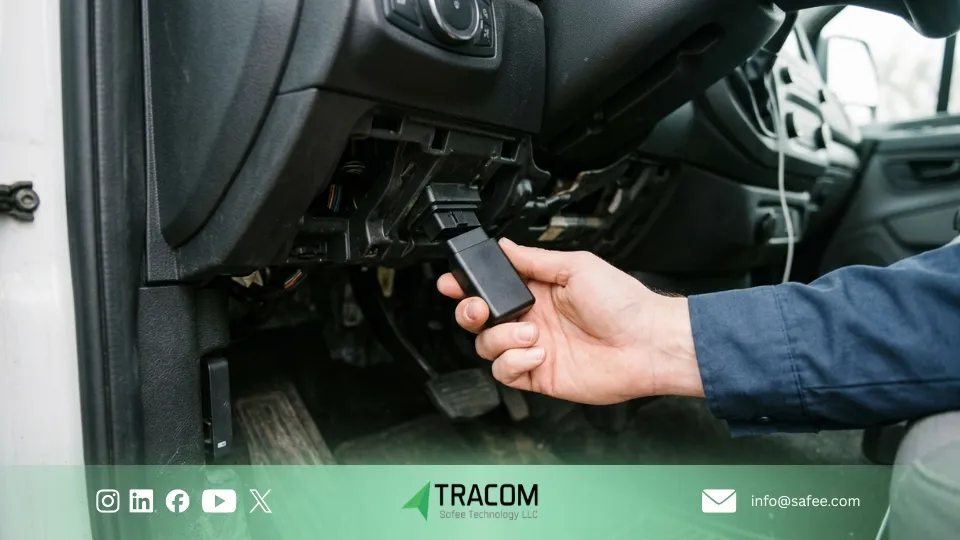
OBD-II plug-in trackers | OBD port power | Plug-and-play | Light vehicles, pilots, rentals, fast rollout | Visible, removable, limited fit for heavy trucks/trailers |
Battery-powered or solar GPS trackers | Internal battery or solar-assisted battery | Mounted, bolted, or attached | Trailers, containers, movable equipment | Reporting frequency affects battery life |
BLE asset tags and proximity sensors | Small tag battery | Tag plus nearby reader/gateway | Tools, pallets, yard assets, proximity workflows | Not standalone GPS; needs reader coverage |
Use this table as a starting point, not a final answer. The right device mix depends on your asset types, route conditions, security needs, diagnostics requirements, and deployment model.
Here are these types in more details:
Hardwired GPS tracking devices for long-term fleet control
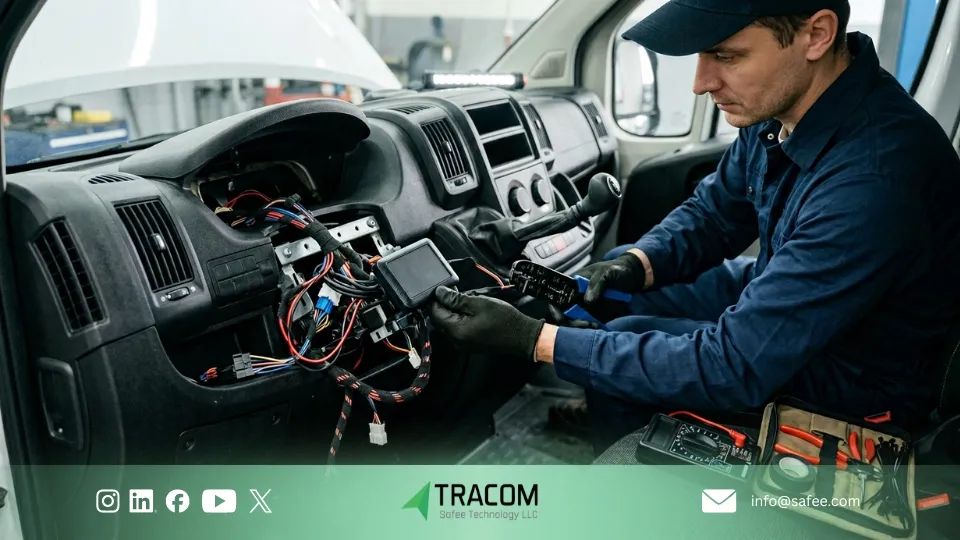
Hardwired tracking devices connect directly to vehicle power and can be installed discreetly. They are usually the strongest option for long-term commercial vehicles because they reduce accidental removal, support stable ignition-based tracking, and can provide a better foundation for diagnostics or driver-event data where the vehicle interface supports it.
- Best for trucks, vans, service vehicles, and long-term owned or leased fleet units.
- Useful when tamper resistance, diagnostics, and consistent event reporting matter.
- Installation quality should be treated as part of the hardware decision, not an afterthought.
For commercial trucks, at Tracom we highlight rugged tracking hardware capabilities such as GNSS/LTE antennas, accessory integration, OBD-II/CAN-bus diagnostics, environmental protection, and high-frequency reporting in our truck tracking device guide. These are the kinds of details procurement teams should confirm before buying devices at scale.
OBD-II plug-in GPS fleet tracking devices for fast rollout
OBD-II plug-in trackers are attractive when speed matters. They can be useful for pilots, light commercial vehicles, temporary fleets, or distributed branches where installation scheduling is difficult. The trade-off is that they are visible, easier to unplug, and may not provide the same diagnostic depth across every vehicle class.
- Best for light vehicles, company cars, and fast proof-of-concept deployments.
- Good when you need visibility quickly and accept the security limitations.
- Needs vehicle-by-vehicle confirmation because not every port delivers the same data quality.
Battery-powered and solar GPS trackers for trailers and unpowered assets
Battery-powered and solar-assisted devices are designed for assets that do not have reliable vehicle power, such as trailers, containers, and certain mobile equipment. They are valuable in GCC logistics, construction, and remote operations where assets may move between yards, depots, and job sites without a powered installation point.
- Best for trailers, containers, and assets that move intermittently.
- The reporting interval must match battery expectations; minute-level updates consume more power.
- Solar trackers must be mounted where they can actually receive daylight.
BLE asset tags for yard, tool, and proximity visibility
BLE tags are useful when the goal is proximity visibility rather than continuous GPS location. They can help fleets monitor tools, pallets, and smaller assets in depots, workshops, and yards. The key design point is reader coverage: BLE tags need nearby gateways, vehicle devices, or fixed readers to create useful events.
- Best for high-volume smaller assets where cellular GPS per item is not practical.
- Useful for zones, yards, depots, and vehicle proximity workflows.
- Not a replacement for standalone GPS tracking on vehicles or trailers.
Also read: The Different Types of GPS Tracking Devices 2026
8 top hardware specs for GPS fleet tracking devices in the Gulf
After you shortlist the device type, evaluate specs through operational risk. The cheapest device can become expensive if it creates weak data, site visits, manual workarounds, or lost confidence in the platform.
1. Connectivity: 4G LTE, Dual SIM, LTE-M, and NB-IoT
Connectivity is the data pipeline. 4G LTE is commonly expected for real-time tracking, while dual-SIM can reduce dependency on one carrier across varied routes. LTE-M and NB-IoT can be useful for lower-power asset use cases where reporting is periodic rather than constant. In the GCC, validate performance across cities, industrial zones, remote yards, ports, and cross-border routes.
2. GNSS Performance and Multi-Constellation Support
Multi-constellation GNSS support can improve positioning availability compared with GPS-only designs, especially in difficult environments. Accuracy matters because it affects geofences, route proof, trip replay, customer disputes, and speed-event credibility.
3. CAN Bus, OBD-II, and Heavy-Vehicle Interfaces
If you need engine signals, odometer, RPM, ignition status, selected fault data, fuel-related signals, or maintenance triggers, the hardware must match the vehicle interface. Light vehicles often use OBD-II, while trucks and heavy vehicles may require CAN/J1939-style support depending on configuration.
4. Offline Storage and Store-and-Forward Logic
Devices will lose coverage in basements, tunnels, remote routes, yards, and industrial zones. Fleet-grade gps fleet tracking devices should store trips and events locally, then synchronize when connectivity returns. This protects trip integrity and reporting continuity.
5. Geofence and On-Device Event Logic
A strong device-platform setup should support geofence entry, exit, route deviation, off-hours movement, tampering, and selected driver-safety events. On-device logic can help reduce the delay between field behavior and operational action.
6. Environmental Durability: Heat, Dust, Vibration, and Mounting
GCC and global fleets often operate in harsh weather, dusty yards, hot parking areas, and vibration-heavy vehicles. Check IP rating, operating temperature, antenna placement, casing quality, and mounting design before choosing hardware for external or demanding environments.
7. OTA Configuration and Firmware Updates
Fleet teams should avoid unnecessary site visits for every configuration change. Over-the-air configuration and updates can help IT and operations manage reporting intervals, device rules, and firmware improvements more efficiently.
8. Accelerometer, Tamper, Panic, and Event Inputs
Safety and security workflows often need harsh braking, harsh acceleration, movement while parked, impact, panic, tamper, or external input events. The question is not only whether the device has a sensor, but whether it produces consistent and usable events in your operating conditions.
At Tracom, our product presents its GPS tracking device as a high-grade fleet device designed for precise tracking, strong connectivity, and reliable performance for business fleets.
Want to avoid devices that look good on paper but fail in the field? Request a Tracom recommendation based on your fleet type, routes, and operating conditions.
Also read: The Best GPS Car Tracking Devices in the UAE 2026

How to choose GPS fleet tracking devices for GCC and global operations
Choosing the right GPS fleet tracking devices should start with your fleet’s operating needs, not the lowest device price. GCC and global fleets often deal with mixed vehicles, long-distance routes, harsh weather, remote sites, and different reporting requirements. The best choice is usually not one tracker for everything, but the right device mix for each asset type and use case.
1. Identify what you need to track
Start with your asset types. Powered vehicles may need hardwired GPS trackers or OBD devices. Heavy trucks may require more rugged hardware, stable power connection, and vehicle interface compatibility. Trailers and containers often need battery-powered or solar GPS trackers. Tools, pallets, and yard assets may be better suited for BLE tags when reader coverage is available.
2. Define how often you need updates
High-frequency tracking is useful for live dispatch, high-risk routes, security-sensitive operations, and urgent alerts. But not every asset needs constant updates. For trailers, containers, or low-movement equipment, periodic reporting may give enough visibility while protecting battery life.
3. Match connectivity to real routes
A fleet working inside city zones has different connectivity needs from a fleet moving between Saudi Arabia, the UAE, Oman, Qatar, Bahrain, Kuwait, or remote project sites. Before rollout, identify where your fleet loses signal and choose devices, SIM options, and buffering features that protect data continuity.
4. Confirm the data your teams need
Location alone may not be enough. If your team needs maintenance signals, driver behavior data, fuel review, fault visibility, or vehicle status, avoid basic location-only devices. Choose hardware that supports the right vehicle interface and confirm which signals are available for each vehicle class.
5. Make sure the platform supports the full device mix
A mixed fleet may use hardwired trackers, OBD devices, trailer trackers, solar units, and BLE tags at the same time. This only works when the platform gives managers one clear view of vehicles, assets, alerts, trip history, and reports.
At Tracom, we help businesses choose GPS fleet tracking devices as part of a complete device-plus-platform setup, connecting hardware selection with fleet visibility, alerts, reports, and deployment support across GCC and global operations.
Checklist for GPS fleet tracking devices
Question to answer | Why it matters |
Which assets are powered, unpowered, or small enough for BLE? | Prevents forcing one device type across incompatible assets. |
Do we need diagnostics, driver behavior data, or location only? | Protects maintenance, safety, and reporting goals from weak data. |
Where do we have coverage gaps? | Guides network, dual-SIM, offline storage, and reporting choices. |
What environment will the device face? | Heat, dust, vibration, and external mounting affect hardware durability. |
Who will own alerts and reports after rollout? | Avoids installing tracking without an operating workflow. |
Do we need OTA configuration and central device management? | Reduces site visits and supports scalable fleet operations. |
How will the system integrate with operations, IT, or reporting tools? | Ensures tracking data becomes usable business information. |
Connectivity and network planning for GCC fleet tracking
Connectivity is often the silent factor behind failed tracking projects. A device can have strong GNSS performance, but if it cannot transmit or store data properly, your team will see delayed trips, missing events, and unreliable alerts.
- Use 4G LTE as a practical baseline for real-time fleet visibility where coverage supports it.
- Consider dual-SIM or multi-carrier strategies for fleets moving across varied coverage areas.
- Use LTE-M or NB-IoT for selected low-power asset cases where reporting is periodic.
- Confirm antenna placement and vehicle environment, especially in heavy trucks and metal-dense installs.
- Test real routes before buying at scale, especially for remote, desert, industrial, or cross-border operations.
For a deeper operational view, this article on live fleet visibility and real-time alerts explains how device data becomes live status, trip history, exception alerts, geofencing, and role-specific operational views.
How GPS fleet tracking devices connect to fleet software
Hardware produces data. Software turns that data into decisions. A fleet platform should help operations, safety, maintenance, and management teams work from the same version of truth.
- Live map and fleet status views for dispatch and operations.
- Trip history, route replay, and evidence for customer or incident review.
- Alerts for overspeed, harsh events, geofence breaches, tampering, unauthorized use, and panic signals where configured.
- Reports for utilization, safety, fuel, maintenance, productivity, and performance review.
- Permissions and role-based access so each team sees the data it needs.
- APIs, exports, or integrations where IT teams need ERP, TMS, or internal reporting connections.
Our Features and Services are useful internal references for teams evaluating platform capabilities, over-the-air configuration, and operational support. For use-case planning across industries, review our Use Cases.
Why choose Tracom for GPS fleet tracking devices in the GCC
Choosing gps fleet tracking devices is not only a hardware purchase. It is a deployment decision that affects visibility, safety, driver accountability, maintenance timing, customer service, and management reporting. At Tracom, we help B2B fleets choose device types based on operating reality, not only unit price.
Our approach is practical: understand the vehicle mix, identify route and coverage conditions, define the data your teams need, then recommend hardware and platform workflows that support those goals. For GCC and global fleets, that means considering heat, dust, long routes, distributed branches, heavy vehicles, trailers, and the need for clean reporting across departments.
- For procurement: a clearer comparison of hardwired, OBD, battery/solar, and BLE options.
- For fleet managers: live visibility, trip history, driver-event context, and exception workflows.
- For IT evaluators: platform fit, device management, OTA capability, and integration readiness.
- For safety and operations teams: alerts, geofences, tamper events, and reporting that supports action.
Ready to compare hardware options for your real fleet, not a generic brochure? Request a Tracom recommendation.
FAQs about GPS fleet tracking devices
What are GPS fleet tracking devices?
GPS fleet tracking devices are commercial hardware units installed in vehicles or attached to assets to collect location, movement, and selected vehicle or event data. They send that data to a fleet platform where teams can monitor live status, trips, alerts, and reports.
What is the best type of GPS fleet tracking device for GCC fleets?
There is no single best type for every fleet. Hardwired devices fit long-term vehicles and trucks, OBD devices fit fast light-vehicle deployment, battery or solar trackers fit trailers and unpowered assets, and BLE tags fit tools or proximity tracking. Most mature fleets use a mix.
Are OBD trackers better than hardwired GPS tracking devices?
OBD trackers are faster to deploy, but hardwired devices are usually more secure and better suited for long-term commercial operations. The best choice depends on vehicle type, tamper risk, diagnostics needs, and installation constraints.
What hardware specs matter most for commercial fleet tracking?
Important specs include 4G LTE or suitable IoT connectivity, dual-SIM where needed, GNSS performance, CAN or OBD support, offline storage, geofence and event logic, environmental durability, OTA configuration, and reliable accelerometer or tamper-event data.
Can one platform manage different GPS fleet tracking devices?
Yes, if the platform is designed for mixed fleets. A unified dashboard can combine data from hardwired devices, OBD trackers, trailer units, and selected asset tags so teams avoid switching between disconnected systems.
How can Tracom help us choose GPS fleet tracking devices?
Tracom can review your vehicle types, routes, coverage conditions, diagnostics needs, reporting goals, and deployment constraints, then recommend a practical hardware and platform setup for your GCC or global fleet operation.