

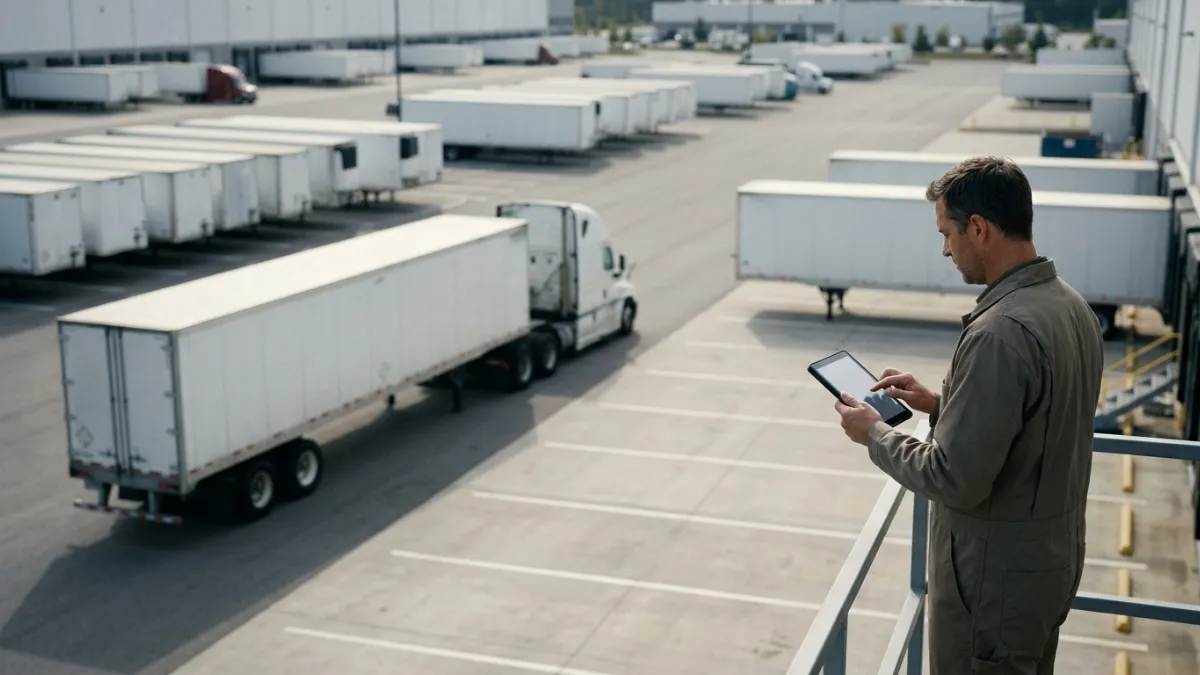
Your tractor may be visible on the map, but what happens after the trailer is dropped at a yard, port, cross-dock, customer site, or waiting area? For many logistics teams, that is where the real blind spot begins. The truck drives away, the trailer stays behind, and dispatch is left asking the same costly questions: where is the trailer, who moved it, when was it opened, and how long has it been sitting?
This guide explains how a trailer tracker works, how to choose the right trailer tracking device, when to use a solar or battery-powered setup, how door sensors and geofencing protect cargo, and how a chassis tracker supports port, terminal, and intermodal operations. You will also see how Tracom connects GPS hardware, real-time alerts, geofencing, tamper awareness, and remote monitoring into a practical fleet visibility workflow.
If your fleet loses visibility after trailers are dropped, uncoupled, moved through yards, or parked at customer sites, Tracom can help you turn trailer location, geofences, alerts, and status data into a practical control workflow for dispatch, yard teams, security, and management.
What is a trailer tracker?
A tracking device is a GPS-enabled tracking device installed on a trailer to monitor location, movement, geofence events, and trailer status independently of the tractor pulling it. When configured with compatible sensors, it can also support door-status events, cargo-temperature monitoring, and other cargo-security data. It helps fleet operators keep visibility when trailers are parked, dropped, transferred, or moved without the assigned truck.
The key difference is independence. A tractor GPS device tells you where the truck is. A trailer GPS tracking device tells you where the trailer and cargo are, even when the tractor is somewhere else. That distinction matters for semi-trailers, refrigerated trailers, flatbeds, container chassis, rental trailers, and high-value cargo movements across the GCC, Africa, Europe, and global trade routes.
Why is trailer tracking different from truck tracking?
A trailer behaves differently from a vehicle, so it needs a different tracking logic. A vehicle has an engine, ignition signal, driver context, and stable power source. A trailer often has none of these. It can sit for days, move suddenly, get dropped in a crowded yard, or change tractors more than once in the same week.
No continuous power source
Most trailers cannot support a standard vehicle tracking installation because they do not provide reliable continuous power. That is why a professional trailer tracking device usually depends on an internal battery or solar-assisted charging. The system must conserve power while stationary and report more frequently when movement starts.
Frequent coupling and uncoupling
In drop-and-hook operations, trailers move through multiple hands. A semi-trailer may leave a depot, stop at a cross-dock, sit at a customer yard, and then continue with another tractor. Without independent trailer tracking, your team may know where the tractor went but lose confidence in where the trailer actually is.
Long dwell times in yards and customer sites
Trailer operations often include long stationary periods. For GCC logistics hubs, ports, free zones, industrial areas, and cross-border routes, dwell time can quickly turn into detention costs, missed appointments, or yard congestion. A trailer visibility system gives operations teams a searchable view instead of relying on calls, manual lists, or walking the yard.
External exposure and harsh conditions
Trailers face heat, dust, vibration, road spray, washdowns, and impact risk. In the Gulf, high temperatures and outdoor exposure add more pressure on hardware and installation quality. A consumer tracker may look cheaper at purchase, but it rarely fits commercial trailer operations where uptime, security, and audit trails matter.
How does a trailer tracking device work?
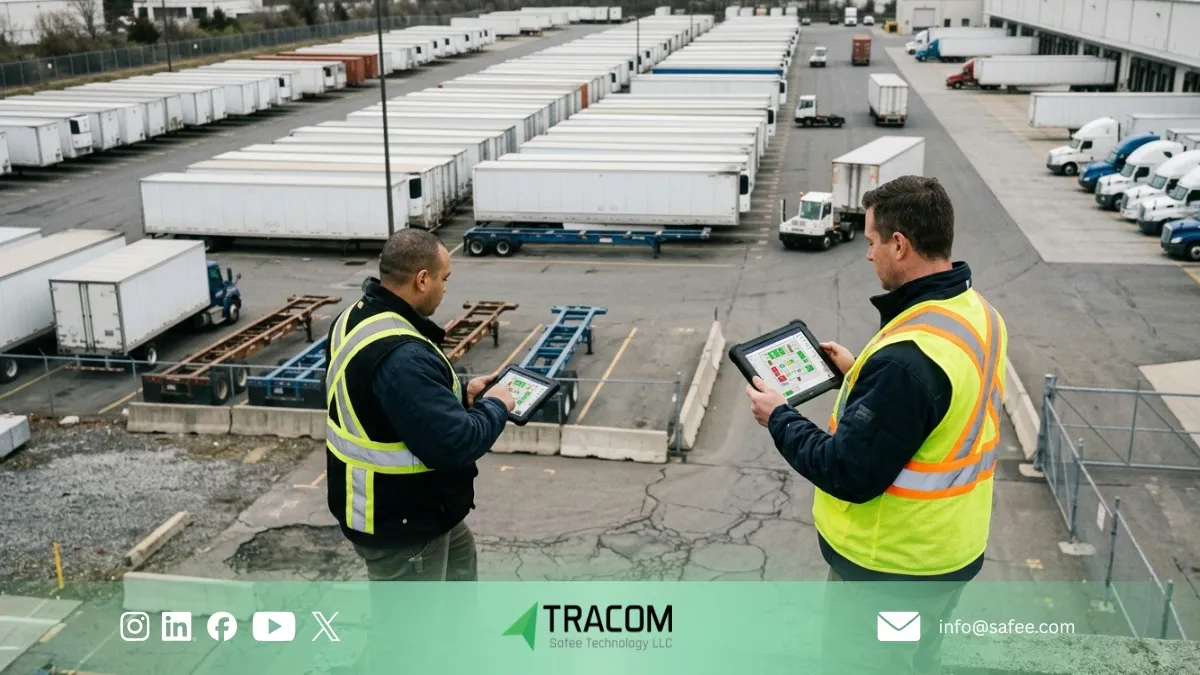
A modern trailer tracking device combines three layers: positioning, connectivity, and power logic. The device receives GNSS location signals, transmits data through cellular networks when coverage is available, stores records during weak coverage, and adjusts reporting based on whether the trailer is moving or stationary. This is the same operational mindset behind fleet telematics: location becomes useful only when it turns into alerts, reports, and decisions.
For a deeper explanation of how GPS data turns into fleet action, read our GPS fleet tracking device guide and our GCC telematics guide.
Battery-only trailer tracker
A battery-only tracking workflow is useful when fast deployment and flexible mounting are the priority. It works well for assets that do not move every day, fleets that can manage battery maintenance, or trailer groups where solar exposure is limited. The main decision is reporting frequency. More updates mean better live visibility but shorter battery life, while fewer updates preserve power but reduce detail.
Solar trailer tracker
A solar-assisted trailer tracker uses a battery supported by a small solar panel. This setup is attractive for large trailer fleets because it reduces battery maintenance and supports longer field life when the panel receives enough daylight. It is especially useful for trailers parked outdoors in depots, yards, logistics parks, and regional transport operations.
Solar performance still depends on real conditions. A panel mounted in shade, covered by dirt, or placed where cargo structures block sunlight will behave more like a battery-only unit. Installation planning matters as much as device selection.
Offline storage and coverage gaps
GCC and global logistics routes can include ports, tunnels, remote industrial zones, desert roads, and weak-signal areas. A reliable trailer gps tracking device should store events when connectivity drops and sync them when coverage returns. This protects the audit trail and helps your team understand what happened even when live transmission was temporarily unavailable.
Trailer tracker features that protect cargo
The best trailer tracker setup is not just a dot on a map. It should tell your team what event happened, where it happened, and what action is needed. At Tracom, we focus on practical alerts and workflows that help fleet teams respond earlier instead of discovering issues after the delivery is already at risk.
Geofencing for yards, ports, and customer sites
Geofencing creates virtual zones around depots, warehouses, ports, customer locations, restricted areas, and approved parking zones. When a trailer enters or exits a zone, the system records the event and can trigger an alert. Our fleet features include advanced geofencing controls designed to support real-time operational decisions.
For trailer fleets, geofencing helps answer direct questions: did the trailer arrive at the right location, did it leave during approved hours, is it still at the customer site, and is it sitting longer than expected?
Movement alerts and tamper awareness
A parked trailer should not move without a reason. Movement alerts help detect unauthorized towing, unexpected yard movement, or possible theft. Tamper alerts add another layer by notifying your team when someone attempts to interfere with the device or installation. This is valuable for high-value cargo, long dwell periods, and trailers staged in exposed locations.
Door sensors for access visibility
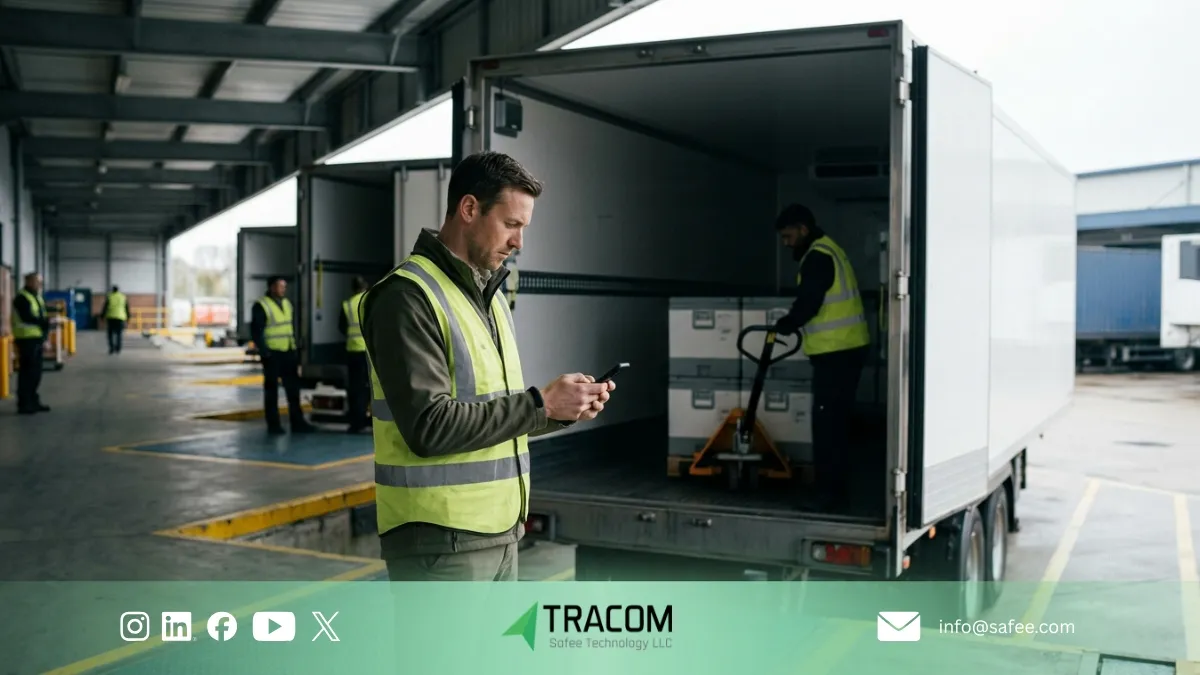
When a trailer tracking device is configured with compatible door sensors, your team can see when a trailer door opens or closes and where that event happened. This supports cargo security, delivery proof, and chain-of-custody reviews.
A door event at a customer site may confirm unloading. A door event outside an approved location may require immediate investigation. For high-value cargo, cross-border movements, and long dwell periods, door-status visibility helps teams move from manual follow-up to event-based response.
Temperature monitoring for reefer trailers
For refrigerated trailers, location alone is not enough. Cold-chain operations need to know whether temperature stayed inside the required range during waiting, loading, transit, and delivery.
When the deployment includes compatible temperature sensors, a trailer tracking device can support temperature logs, threshold alerts, and exception review. This helps food, pharmaceutical, and temperature-sensitive logistics teams investigate issues earlier instead of discovering risk after cargo claims.
Yard Visibility: Find any trailer faster
Yard visibility is often where trailer tracking creates fast operational value. When a yard holds dozens or hundreds of trailers, the old method is slow: call the yard team, ask the spotter, search manually, or rely on the last person who remembers where the trailer was dropped. That is wasted time.
With a trailer tracker, your team can search by trailer number, see the last reported position, verify whether it is in-yard or off-site, and identify how long it has been waiting. This supports dispatch planning, dock scheduling, faster turns, and better asset utilization.
Dwell time and detention control
Dwell time becomes visible when the platform records arrival and departure events automatically. If a trailer sits too long at a customer site or depot, your team can act earlier. Over time, the data helps identify bottlenecks, recurring detention points, and trailers that are underused or misplaced.
Trailer status at a glance
A useful dashboard should make trailer status easy to read. Common views include in-yard, in-transit, at customer site, in maintenance, idle too long, door opened, geofence breach, or movement after hours. The goal is not more data. The goal is a clean exception view that helps dispatch and operations teams take action.
Want to reduce yard search time, trailer detention, and missed trailer movements? Contact our experts to configure geofences, trailer-status views, and alert rules around your real yard, port, depot, and customer-site workflows.
Trailer tracker setups by fleet type
The right configuration depends on the trailer type, cargo risk, power reality, and reporting needs. A semi trailer GPS tracker is not always configured the same way as a chassis tracker or reefer trailer setup.
Semi trailer GPS tracker for dry vans and linehaul fleets
A semi trailer GPS tracker is usually focused on location, geofence events, movement alerts, yard visibility, dwell time, and movement history between depots, customer sites, and routes.. For dry vans and linehaul fleets, the priority is knowing whether the trailer is moving, where it was dropped, when it reached a customer site, and whether it left an approved zone.
Reefer trailer tracking for cold chain
Reefer trailers need all the basics plus cargo condition monitoring. A trailer tracking device for cold chains should support location visibility, door events, temperature thresholds, and history reports. This helps operations teams review exceptions before they become cargo claims.
Flatbed and specialized trailer tracking
Flatbeds and specialized trailers often carry high-value or oversized cargo. For these assets, geofencing, movement alerts, tamper awareness, and route visibility are usually more important than door sensing. The configuration should match the risk profile of the cargo and the route.
Chassis tracker for intermodal operations
A chassis tracker is installed on the wheeled frame used to move shipping containers between ports, terminals, depots, and distribution centers. It helps operators know which chassis is available, where it is sitting, when it entered or left a terminal, and how long it has been idle. In busy port and intermodal operations, that visibility helps reduce search time and improve asset rotation.
What does Tracom add for GCC and global trailer fleets?
Tracom is built for commercial fleet operations that need more than basic trailer location. For trailer-heavy fleets, the goal is not to watch another dot on a map. The goal is to reduce missing trailers, control yard movement, protect cargo, verify site arrival, review dwell time, and respond faster when an exception happens.
With Tracom, trailer tracking can be planned around practical operating roles:
- Dispatch teams can see trailer location, movement status, and arrival or exit events.
- Yard teams can reduce manual trailer searches and improve trailer rotation.
- Security teams can respond to off-hours movement, geofence exits, and tamper-aware alerts.
- Operations teams can monitor dwell time, detention risk, and trailer availability.
- Management teams can review exception trends, underused assets, and site-level performance.
This makes the trailer tracker part of a wider fleet visibility system, supported by GPS hardware, real-time data, geofencing, intelligent alerts, remote monitoring, and reporting workflows.
For GCC fleets, this matters because trailers often move through UAE, Saudi Arabia, Qatar, Kuwait, Oman, Bahrain, ports, free zones, warehouses, industrial sites, and cross-border routes. For global fleets, the same challenge expands across more handoffs, longer dwell times, and more complex custody chains.
Planning a trailer tracker rollout for dry vans, reefers, flatbeds, chassis, rental trailers, or specialized assets? Book a consultation to define the right device setup, power strategy, geofences, alerts, sensors, and dashboard views before deployment.
Trailer tracker selection checklist
Before choosing a trailer tracker, evaluate the deployment as an operating system, not just a hardware purchase. Use this checklist to reduce mistakes before rollout.
- Define which trailers need tracking: dry van, reefer, flatbed, chassis, rental, or specialized assets.
- Choose the power strategy: battery-only, solar-assisted, or a mixed setup by asset type.
- Set moving and stationary reporting rules to balance visibility with battery life.
- Confirm rugged mounting requirements for heat, dust, vibration, washdowns, and road exposure.
- Decide which geofences are required: yard, warehouse, port, terminal, customer site, restricted zone, and approved parking.
- Specify alert rules for movement after hours, geofence exits, tamper attempts, configured door events, and configured temperature exceptions.
- Confirm whether compatible door sensors, temperature sensors, or other cargo-monitoring integrations are required.
- Plan dashboard views for dispatch, security, yard operations, and management reporting.
- Test coverage realities on your actual GCC or international routes, not only in the main yard.
- Define who receives each alert and what action they should take.
Shortlisting trailer tracking devices? Contact Tracom before rollout so we can recommend the right tracker, alert rules, and deployment model for your fleet.
FAQ about trailer trackers
How does a trailer tracker work without power?
A trailer tracker works through an internal battery or a solar-assisted battery. It saves energy by reporting less often when stationary and more frequently when moving. The exact runtime depends on reporting frequency, temperature, coverage, sunlight exposure, and device configuration.
Can I track a trailer separately from the truck?
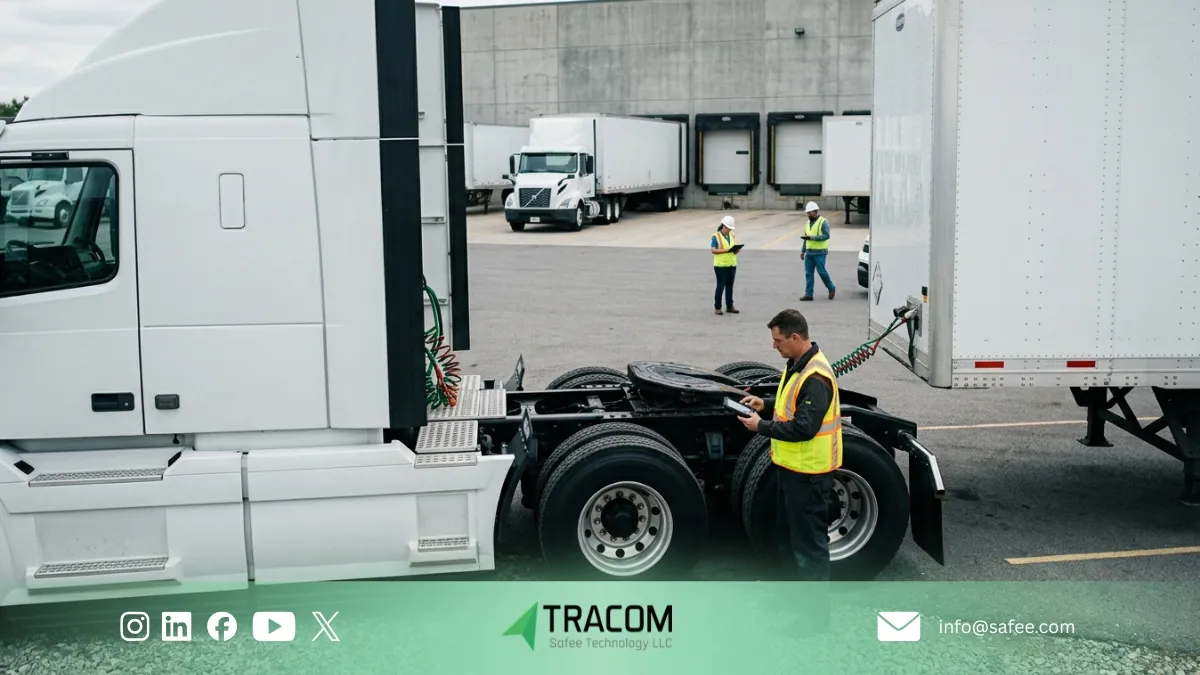
Yes. A trailer tracking device is installed on the trailer itself, so it reports independently from the tractor. When the trailer is uncoupled, you still see trailer location and events instead of losing visibility when the truck leaves.
What is the best semi trailer GPS tracker for a fleet?
The best semi trailer gps tracker is the one that fits your operation. For long-haul and yard-heavy fleets, prioritize battery or solar autonomy, rugged mounting, geofencing, movement alerts, offline storage, and dashboard workflows that support dispatch and yard teams.
Can a trailer tracker monitor door opening?
Yes, when the trailer tracking device is connected to compatible door sensors. The system can record when and where the door opened or closed, which supports cargo security, delivery proof, exception review, and chain-of-custody documentation.
Can a trailer GPS tracking device monitor temperature?
Yes, if the trailer tracking device supports compatible temperature sensors and the deployment is configured for cold-chain monitoring. This is useful for reefer trailers, food logistics, pharmaceutical transport, and other temperature-sensitive operations where cargo condition matters as much as location.
What is a chassis tracker?
A chassis tracker is a GPS tracking device installed on an intermodal chassis. It helps operators locate chassis assets, measure idle time, verify terminal movements, and improve utilization across ports, depots, and distribution networks.
Does trailer tracking work for GCC fleets?
Yes, but the setup must match the environment. GCC trailer fleets should consider heat, dust, long outdoor parking, cross-border routes, port operations, and coverage gaps. Solar placement, rugged mounting, geofencing, and alert configuration are all important for reliable results. For reliable rollout, Tracom can help you test route conditions, define geofences, choose the right power setup, and configure alerts around your actual GCC fleet workflow.