

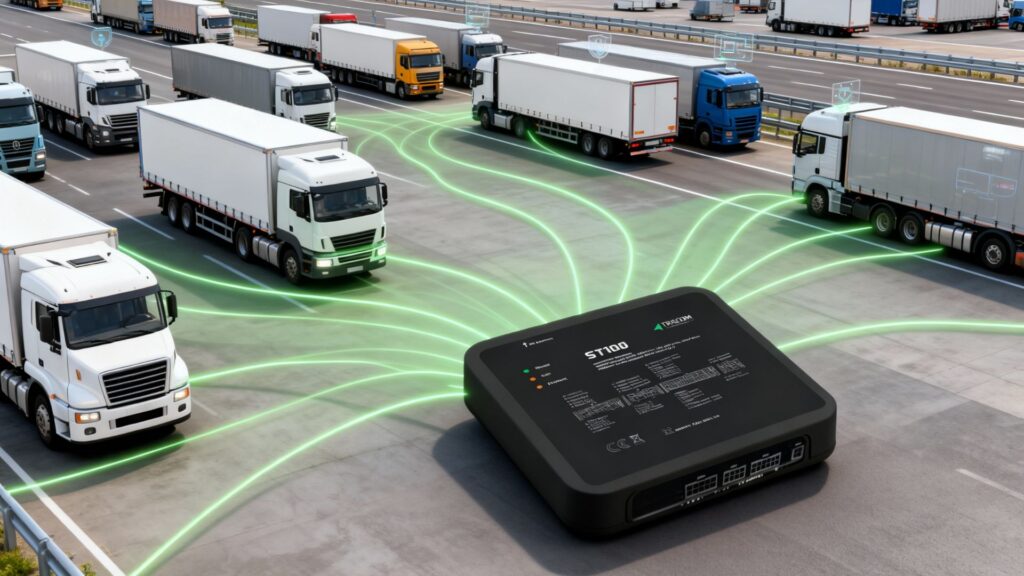
Running a modern fleet requires clear visibility, accurate data, and full control. That’s why understanding what a fleet GPS tracking device is—and how it works—is essential for improving efficiency, safety, and cost management.
In this guide, you’ll quickly learn the GPS tracking device meaning, how vehicle GPS tracking devices collect and transmit data, and the key features that matter for businesses that rely on tracking devices for fleet operations.
You’ll also see how advanced solutions like the Tracom ST100 deliver reliable, real-time telematics for commercial fleets.
Ready to strengthen your fleet operations? Speak with Tracom experts today.
Understanding the Meaning of a GPS Tracking Device
To fully grasp the meaning of a fleet GPS tracking device, it’s important to view it as far more than a simple location tool. For any fleet operator, it functions as a complete telematics system, combining GNSS satellite data, LTE/GSM connectivity, and built-in sensors to monitor real-time vehicle behaviour with precision.
A company vehicle tracking device captures critical operational metrics such as:
- Speed and routing
- Acceleration and harsh braking
- Idling and fuel waste
- Ignition events
- Unauthorized movement
- Engine behaviour (via OBD-II CAN-bus)
When you manage multiple vehicles, these aren’t just data points; they are the backbone of operational control.
In commercial environments, businesses depend on a commercial GPS tracking device not only to pinpoint vehicle locations but also to automate workflows, improve safety, verify compliance, reduce hidden costs, and detect tampering before it becomes a larger issue.
If you want to unlock deeper telematics intelligence across your fleet, our team can guide you toward the most effective setup for your operational needs.
Read also: Best practices for GPS tracker placement in fleet vehicles
Why Businesses Depend on Tracking Devices for Fleet Efficiency?
Fleet-operating environments move fast, and even small inefficiencies—poor route planning, driver misconduct, fuel waste, or unauthorized vehicle use—can directly reduce profitability.
When you oversee multiple assets, these issues aren’t theoretical; they show up as higher fuel bills, delayed deliveries, customer complaints, and unexpected downtime.
In industries where uptime is critical, choosing the right fleet GPS tracking device helps ensure uninterrupted performance, safer trips, and complete operational transparency.
This is why businesses, including yours, depend on vehicle GPS tracking devices to maintain day-to-day efficiency and control.
Modern tracking devices enable you to:
- Improve routing accuracy
- Prevent unauthorized or after-hours trips
- Strengthen theft prevention
- Reduce unnecessary mileage
- Increase driver accountability
- Reduce insurance-related risks
- Streamline maintenance and servicing schedules
If you’re aiming to reduce operational waste and strengthen oversight across your fleet, exploring advanced tracking solutions like Tracom’s system can help you achieve measurable improvements.
Read also: How to choose the best fleet telematics device
How Do Fleet GPS Tracking Devices Work?
A fleet GPS tracking device uses a combination of satellite signals and cellular communication to deliver real-time, high-accuracy vehicle data.
For fleet operators, understanding how this process works helps explain why reliable tracking is essential for safety, routing efficiency, and full operational visibility.
GNSS Satellite Reception
The device receives location signals from multiple constellations, such as: GPS, GLONASS, Galileo, QZSS, and BDS.
This multi-constellation support strengthens accuracy even in congested urban areas or remote highways where single-system devices often struggle.
Cellular Transmission
Once the location data is processed, the device transmits it to your fleet platform through LTE or GSM networks, ensuring you receive continuous updates without manual checks or delays.
Advanced Hardware Integration
A commercial solution like the Tracom ST100 includes: Internal GNSS and LTE antennas, RS232 ports, OBD-II CAN-bus interface, IP56 protection, and Second-by-second reporting capability
These components work together to maintain uninterrupted visibility and responsive telematics across all driving conditions.
If your fleet requires consistent accuracy and stronger operational control, connect with Tracom specialists to see how advanced tracking hardware can support your daily operations.
Read also: Top GPS vehicle tracking devices for reliable monitoring
Key Features of a Modern GPS Fleet Tracking Device
A modern fleet GPS tracking device must deliver accuracy, durability, and reliable communication across all driving conditions. For fleet operators, these features directly impact safety, route efficiency, and day-to-day operational control.
The Tracom ST100 provides this level of performance through:
- Multi-constellation GNSS for stronger accuracy in cities, tunnels, and remote routes
- LTE/GSM connectivity ensuring consistent real-time updates
- Internal GNSS and LTE antennas for stable performance without external modules
- Tampering and unplug detection to protect vehicles from misuse
- Jamming detection to identify signal interference attempts
- Acceleration and deceleration monitoring to improve driver accountability
- IP56-rated durability to withstand dust, heat, and harsh road conditions
- Second-by-second data processing for precise trip and incident analysis
- OBD-II CAN-bus diagnostics offering insights into engine and vehicle behaviour
- OTA configuration and firmware updates for remote fleet management
These capabilities position the ST100 as one of the most advanced vehicle GPS tracking devices for fleets that require continuous, high-precision visibility.
If your operations depend on accurate, real-time fleet intelligence, request a Tracom ST100 demo today.
Benefits of Fleet GPS Tracking Devices for Businesses
Organizations that adopt a reliable fleet GPS tracking device gain immediate and measurable operational advantage, especially when managing high-mileage or multi-vehicle fleets.
Improved Driver Performance
Continuous monitoring encourages safer, more compliant driving habits, reducing accidents, harsh events, and customer complaints.
Lower Fuel Costs
Less idling, optimized routing, and better driving behaviour directly reduce fuel waste—one of the highest expenses in any fleet operation.
Greater Fleet Visibility
Centralized real-time oversight allows managers to respond faster to incidents, adjust routes, and allocate resources with more confidence.
Better Maintenance Control
Diagnostic data from OBD-II integration helps prevent breakdowns, minimise downtime, and keep vehicles on predictable service schedules.
Enhanced Security
A company vehicle tracking device provides instant alerts for unauthorized usage, towing attempts, or tampering, protecting your assets around the clock.
With insights delivered through a modern fleet telematics device, your team gains stronger control over daily operations and can scale efficiency across the entire fleet.
If you’re ready to cut operational waste and strengthen fleet oversight, explore Tracom’s intelligent tracking solutions today.
Common Use Cases for Fleet GPS Tracking Devices
Businesses across multiple industries rely on a fleet GPS tracking device for different operational challenges, whether the priority is safety, asset protection, routing efficiency, or real-time visibility.
-
Logistics and Delivery
Real-time tracking helps optimize routes, improve ETA accuracy, and increase customer transparency—crucial for fleets handling high delivery volume.
-
Construction and Heavy Equipment
Vehicle GPS tracking devices secure high-value machinery, monitor on-site usage, and prevent unauthorized movement—reducing losses and downtime.
-
Rental and Leasing
A commercial GPS tracking device ensures proper vehicle use, tracks mileage for billing accuracy, and protects assets from theft or misuse.
-
Public Transportation & Emergency Fleets
Enhanced visibility improves response times, ensures route compliance, and increases passenger and public safety.
-
Oil & Gas and Remote Operations
Stable GNSS and LTE connectivity keep remote fleets visible at all times, even in harsh or isolated environments.
Whatever your industry, Tracom offers fleet-focused tracking solutions tailored to your operational priorities. Contact Tracom today to choose the right GPS solution for your fleet
Read also: A complete guide to choosing the best GPS car tracking device in the UAE
Why Choose Tracom for Your Fleet GPS Tracking Devices
When your operations depend on accuracy, uptime, and full visibility, you need a fleet GPS tracking device engineered for real commercial conditions not consumer-grade hardware.
Tracom builds its technology specifically for demanding fleet environments, and the Tracom ST100 is designed for long-term, high-performance use.
The ST100 includes:
- GNSS (GPS, GLONASS, Galileo, QZSS, BDS) for maximum positioning accuracy
- LTE/GSM communication for uninterrupted real-time updates
- RS232 and OBD-II CAN-bus integration for rich vehicle diagnostics
- IP56 ingress protection for durability in tough environments
- Anti-tampering and unplug detection for asset security
- Jamming detection for interference protection
- 2600 mAh internal backup battery for continuous tracking
- OTA configuration and firmware updates for remote management
- Second-by-second reporting for precise telematics insight
Trusted for accuracy, dependability, and long-term performance, the ST100 is the preferred commercial GPS tracking device for organizations that prioritise:
- Operational efficiency
- Long-term hardware value
- Enterprise-grade telematics capabilities
- Strong security and anti-tampering protection
FAQs about Fleet GPS Tracking Device
1. What is the meaning of GPS tracking device?
It refers to a telematics unit that uses GNSS satellites and cellular networks to monitor and transmit real-time vehicle location and performance.
2. What Is a Fleet GPS Tracking Device?
A device installed in commercial vehicles to track routes, driver behavior, and operational performance for improved visibility and efficiency.
3. How does GPS work for tracking?
GPS works by receiving GNSS satellite signals to determine accurate location, then sending that data to a fleet platform using LTE/GSM communication.
4. How far can you track a GPS device?
Tracking distance is unlimited as long as the device maintains GNSS visibility and cellular network connectivity.
5. What are types of GPS Fleet Tracking Devices?
Types include wired GPS trackers, OBD-II plug-in trackers, asset trackers, and rugged devices designed for heavy-duty fleet operations.