

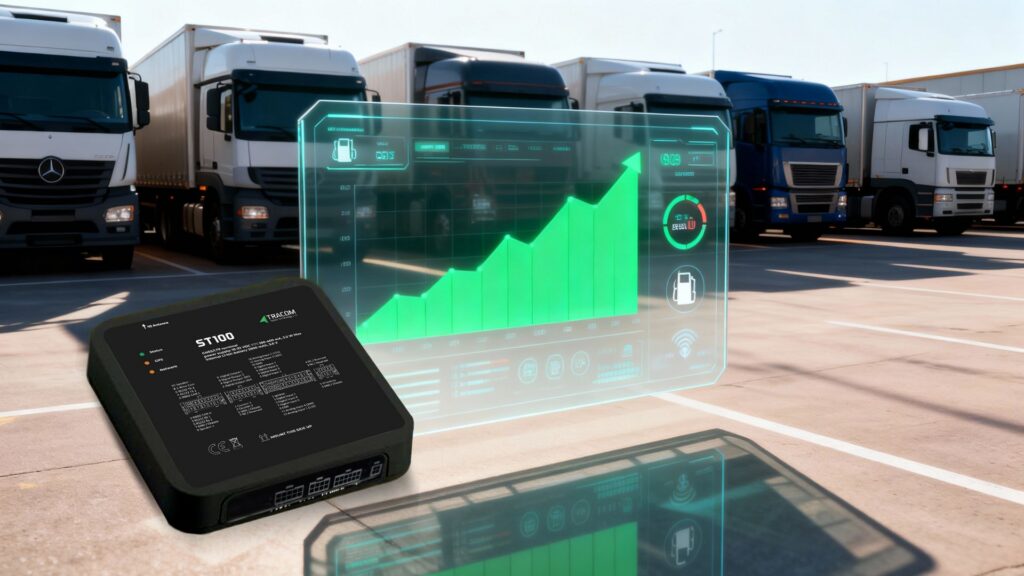
Fuel expenses continue to represent one of the largest and most unpredictable cost factors for transportation and logistics companies. In high-mileage operations, even small inefficiencies—excessive idling, harsh driving, or poor route selection—can dramatically increase annual fuel budgets.
As a result, modern businesses are shifting toward smarter technologies such as the fleet telematics device, enabling them to monitor fuel-related behaviors in real time and correct costly trends before they escalate.
Today’s fleets rely on advanced telematics tracking device solutions to capture performance data second by second.
Companies that previously depended on standard automobile GPS devices for basic navigation now require integrated telematics platforms that offer deeper analytics, stronger visibility, and measurable fuel savings.
This guide explains how telematics reduces fuel waste, what key features matter, and why the Tracom ST100 is the ideal solution for GCC fleets seeking reliability, accuracy, and operational intelligence.
Take control of your fuel expenses—contact Tracom for a customized telematics strategy today.
How Telematics Helps Cut Fuel Use in Fleet Vehicles
Telematics technology captures extensive vehicle data that directly influences fuel consumption. A modern fleet telematics device measures idle time, speeding, harsh acceleration, harsh braking, route deviations, and unnecessary mileage—all of which contribute to rising fuel costs.
Unlike traditional navigation tools, a telematics tracking device delivers:
- Real-time analytics
- Driver performance monitoring
- Predictive alerts
- Second-by-second movement data
A telematics GPS device processes this information immediately and transmits it through LTE/GSM networks, enabling fleet managers to take action instantly.
These insights go far beyond what older devices can offer, making telematics an essential part of any fuel-saving strategy.
Read also: Best practices for GPS tracker placement in fleet vehicles
What Is a Fleet Telematics Device?
A fleet telematics device is a connected hardware unit installed inside commercial vehicles to monitor movement, driver behavior, vehicle performance, and operational efficiency.
It gathers data from GNSS satellite signals, internal sensors, and the vehicle’s electronic systems, then transmits this information to a unified fleet platform.
The Tracom ST100, for example, includes advanced components such as:
- Multi-constellation GNSS
- LTE/GSM connectivity
- Internal GNSS and LTE antennas
- RS232 interface
- OBD-II CAN-bus integration
- Internal data storage
- IP56-rated durability
- Second-by-second reporting
- Tampering and unplug detection
These capabilities allow a telematics tracking device to deliver precise vehicle analytics and ensures consistent real-time communication beyond the capabilities of general automobile GPS devices.
Read also: A complete guide to choosing the best GPS car tracking device in the UAE
Difference Between Telematics GPS Devices and Basic Automobile GPS Devices
Fleet operators often ask about the difference between a telematics platform and a simple GPS navigation tool. The distinction is significant:
Telematics GPS Device
- Collects behavioral and operational data
- Communicates through cellular networks
- Tracks acceleration, idling, harsh braking, and tampering
- Integrates with engine diagnostics
- Provides real-time analytics and alerts
- Supports long-term operational optimization
Basic Automobile GPS Devices
- Offer navigation only
- Do not capture behavioral data
- Do not integrate with vehicle electronics
- Lack tampering or jamming detection
- Provide minimal operational insight
A fleet telematics device is a fully integrated management solution, not a simple location tool.
Upgrade from basic GPS to full telematics—choose Tracom ST100.
Key Features of Telematics Devices
High-quality telematics platforms incorporate technologies designed to support accuracy, reliability, and operational intelligence. A modern telematics GPS device—such as the ST100—typically includes:
1. Multi-Constellation GNSS
Supports GPS, GLONASS, Galileo, QZSS, and BDS for superior accuracy.
2. LTE/GSM Connectivity
Ensures fast, continuous real-time communication.
3. Internal Antennas
For stable GNSS and LTE signal performance.
4. Tampering, Unplug, and Jamming Detection
Critical for security, theft prevention, and device integrity.
5. Acceleration & Deceleration Monitoring
Essential for identifying fuel-impacting driving behaviors.
6. Second-by-Second Tracking
Provides unparalleled accuracy for audits, disputes, or incident analysis.
7. OBD-II CAN-bus Integration
Gives deeper visibility into vehicle diagnostics, fuel consumption, and maintenance needs.
8. OTA Configuration & Firmware Updates
Allows remote updates without removing the device.
With these capabilities, the Tracom ST100 outperforms standard automobile GPS devices and offers far more operational value than a conventional telematics tracking device.
How Telematics Tracking Devices Help Monitor Fuel-Related Behavior?
Fuel consumption is heavily influenced by driving style and operational decisions. A modern telematics tracking device identifies behaviors that increase fuel burn, including:
- Hard acceleration
- Harsh braking
- Excessive idling
- High-speed driving
- Route deviations
- Unauthorized trips
A fleet telematics device pairs this behavioral data with GNSS accuracy, enabling managers to detect fuel waste instantly. Meanwhile, a telematics GPS device communicates every event in real time, giving decision-makers an immediate advantage.
Significantly reduce fuel waste—equip your fleet with Tracom ST100.
Route Optimization with Telematics GPS Devices
Efficient routing is one of the most effective ways to reduce fuel consumption. A telematics GPS device analyzes:
- Traffic patterns
- Route history
- Idle hotspots
- Fuel-impacting detours
- Driving environments
- Vehicle assignments
A telematics tracking device identifies the most efficient routes, while a fleet telematics device ensures that the entire fleet follows optimized paths consistently. These capabilities exceed the limited navigation functions of basic devices.
Improve routing efficiency—upgrade to Tracom’s intelligent telematics solution.
Read also: The most
effective tracking devices for trucks and heavy vehicles
Identifying Fuel Waste Using Fleet Telematics Devices
Fuel waste often goes undetected without granular telematics data. A fleet telematics device identifies inefficiencies such as:
- Off-route driving
- Long idle times
- Hard acceleration from stops
- Poor load distribution
- Late-night unauthorized use
- Engine over-revving
A modern telematics GPS device sends real-time alerts that allow immediate corrective actions. Meanwhile, a telematics tracking device supports long-term trend analysis for driver training and operational planning.
Eliminate hidden fuel losses—Tracom can help you analyze the full picture.
Read also: The most effective tracking devices for trucks and heavy vehicles
Why Choose Tracom’s Telematics & GPS Devices for Better Fuel Efficiency?
Tracom offers advanced hardware designed specifically for demanding commercial environments. The Tracom ST100 includes:
- GNSS with GPS, GLONASS, Galileo, QZSS, BDS
- LTE/GSM communication
- Internal antennas for GNSS & LTE
- RS232 interface
- OBD-II CAN-bus integration
- IP56-rated housing
- Tampering and unplug detection
- Jamming alerts
- Second-by-second reporting
- Internal 2600 mAh rechargeable battery
- OTA firmware and configuration updates
These features make the ST100 one of the most effective fleet telematics device options available and a superior alternative to general automobile GPS devices or basic tracking equipment.
Experience unmatched fuel savings—contact Tracom today for a customized telematics plan.
Read also: An essential guide to selecting the best fleet GPS tracking system
Frequently Asked Questions (FAQ)
1. What is a telematics GPS device?
A telematics GPS device is an intelligent unit that combines GNSS location tracking with cellular communication and sensor-based data to monitor vehicle behavior and performance.
2. What is a fleet telematics device?
A fleet telematics device is installed in commercial vehicles to improve visibility, reduce fuel waste, track driver behavior, and optimize fleet operations.
3. How does GPS tracking work in telematics?
The device receives GNSS satellite signals (GPS, GLONASS, Galileo, BDS), processes them, and transmits the data to a fleet platform through LTE/GSM networks.
4. How does telematics reduce fuel consumption?
Telematics identifies harsh driving, idle time, inefficient routing, and unauthorized usage—allowing managers to correct behaviors that increase fuel costs.
5. How is telematics different from basic automobile GPS devices?
Basic GPS devices only provide navigation. Telematics systems capture real-time analytics, driver behavior, vehicle health data, and security alerts.